Update the course data
Copy the latest make_data.py from the Course data page and rebuild (python make_data.py, python day01/ladder.py, python day06/load_tables.py). New for Days 34–37: bakery_machines, bakery_night_jobs, bakery_operations and bakery_rules (tonight's run, Day 34), forklift_certification (Day 35), delivery_stops, delivery_matrix and delivery_fleet (tomorrow morning's bread run, Days 36–37).
34.1 The data and the head baker's plan
Times are minutes after 21:00. Bread and viennoiserie must be packed by 04:00, when the delivery vans load (Days 36–37); cakes and cookies by 05:00 or 06:00. Create day34/bakery_shop.py:
"""Day 34: tonight's bakery run as a job shop, with CP-SAT interval variables.

Import it:  from bakery_shop import load_shop, build_schedule, solve_schedule, dispatch_fifo, check_schedule, clock
"""
import pandas as pd
from ortools.sat.python import cp_model

HORIZON = 900          # minutes after 21:00


def clock(minute, start=1260):
    t = (start + int(minute)) % 1440
    return f"{t // 60:02d}:{t % 60:02d}"


def load_shop(con):
    jobs = con.sql("SELECT * FROM bakery_night_jobs ORDER BY job_id").df().set_index("job_id")
    ops = con.sql("SELECT * FROM bakery_operations ORDER BY job_id, step").df()
    machines = con.sql("SELECT * FROM bakery_machines").df().set_index("machine_id")
    rules = dict(con.sql("SELECT * FROM bakery_rules").fetchall())
    return jobs, ops, machines, rules


def build_schedule(jobs, ops, machines, rules, one_of_each=False, proofer_limit=True, max_wait=True,
                   objective="makespan", oven_down=None):
    """start/end of every operation. one_of_each: only MIX-1 and OVEN-1 work (a short-staffed night).
    objective: "makespan" (finish everything as early as possible) or "lateness" (total minutes late, then makespan).
    oven_down: (from, to) minutes when OVEN-2 is out of service."""
    m = cp_model.CpModel()
    start, end, choice = {}, {}, {}
    on_machine = {mid: [] for mid in machines.index}
    proofer = []
    for r in ops.itertuples():
        key = (r.job_id, r.step)
        start[key] = m.new_int_var(0, HORIZON, f"start_{r.job_id}_{r.step}")
        end[key] = m.new_int_var(0, HORIZON, f"end_{r.job_id}_{r.step}")
        interval = m.new_interval_var(start[key], r.minutes, end[key], f"op_{r.job_id}_{r.step}")
        group = [mid for mid in machines.index if machines.machine_group[mid] == r.machine_group]
        if one_of_each:
            group = group[:1]
        if r.machine_group == "proofer":
            proofer.append(interval)
        elif len(group) == 1:
            on_machine[group[0]].append(interval)
            choice[key] = {group[0]: True}
        elif len(group) > 1:                                       # either machine: one optional interval each
            picks = {}
            for mid in group:
                p = m.new_bool_var(f"{r.job_id}_{r.step}_on_{mid}")
                on_machine[mid].append(m.new_optional_interval_var(start[key], r.minutes, end[key], p, f"{mid}_{key}"))
                picks[mid] = p
            m.add_exactly_one(picks.values())
            choice[key] = picks
    if oven_down is not None:
        on_machine["OVEN-2"].append(m.new_interval_var(oven_down[0], oven_down[1] - oven_down[0], oven_down[1], "oven2_down"))
    for mid, intervals in on_machine.items():
        if mid != "PROOFER":
            m.add_no_overlap(intervals)                            # one operation at a time on each machine
    if proofer_limit:
        m.add_cumulative(proofer, [1] * len(proofer), int(machines.capacity["PROOFER"]))   # 4 racks in the proofer
    for job, g in ops.groupby("job_id"):
        g = g.sort_values("step")
        for a, b in zip(g.itertuples(), list(g.itertuples())[1:]):
            m.add(start[job, b.step] >= end[job, a.step])          # in order: each step after the one before
            if max_wait and a.operation == "proof" and b.operation == "bake":
                m.add(start[job, b.step] <= end[job, a.step] + int(rules["max_wait_proof_to_bake"]))
    finish = {j: end[j, int(ops[ops.job_id == j].step.max())] for j in jobs.index}
    makespan = m.new_int_var(0, HORIZON, "makespan")
    m.add_max_equality(makespan, list(finish.values()))
    late = {j: m.new_int_var(0, HORIZON, f"late_{j}") for j in jobs.index}
    for j in jobs.index:
        m.add(late[j] >= finish[j] - int(jobs.due_minute[j]))
    if objective == "makespan":
        m.minimize(makespan)
    else:
        m.minimize(1000 * sum(late.values()) + makespan)
    m.vars = {"start": start, "end": end, "choice": choice, "makespan": makespan, "late": late}
    return m


def solve_schedule(m, ops, work=10.0):
    """Deterministic search with a fixed amount of work (CP-SAT's "deterministic time"), so every run gives the
    same schedule on the same OR-Tools version. About 20 seconds on a laptop."""
    s = cp_model.CpSolver()
    s.parameters.max_deterministic_time = work
    s.parameters.num_workers = 8
    s.parameters.interleave_search = True
    status = s.solve(m)
    if status not in (cp_model.OPTIMAL, cp_model.FEASIBLE):
        return s, status, None
    rows = []
    for r in ops.itertuples():
        key = (r.job_id, r.step)
        picks = m.vars["choice"].get(key)
        machine = "PROOFER" if r.machine_group == "proofer" else ("-" if picks is None else
                                                                   next(mid for mid, p in picks.items() if p is True or s.value(p)))
        rows.append((r.job_id, r.step, r.operation, machine, s.value(m.vars["start"][key]), s.value(m.vars["end"][key])))
    return s, status, pd.DataFrame(rows, columns=["job_id", "step", "operation", "machine", "start", "end"])


def dispatch_fifo(jobs, ops, machines, one_of_each=False):
    """The head baker's way: jobs in list order, each step as soon as its machine (or a proofer rack) is free."""
    free = {mid: 0 for mid in machines.index if mid != "PROOFER"}
    proofing = []                                                  # (start, end) of everything in the proofer
    rows = []
    for job in jobs.index:
        ready = 0
        for r in ops[ops.job_id == job].sort_values("step").itertuples():
            group = [mid for mid in free if machines.machine_group[mid] == r.machine_group]
            if one_of_each:
                group = group[:1]
            if r.machine_group == "proofer":
                t = ready
                while sum(a < t + r.minutes and t < b for a, b in proofing) >= machines.capacity["PROOFER"]:
                    t = min(b for a, b in proofing if b > t)
                proofing.append((t, t + r.minutes))
                machine = "PROOFER"
            elif group:
                machine = min(group, key=lambda mid: (max(free[mid], ready), mid))
                t = max(free[machine], ready)
                free[machine] = t + r.minutes
            else:
                t, machine = ready, "-"
            rows.append((job, r.step, r.operation, machine, t, t + r.minutes))
            ready = t + r.minutes
    return pd.DataFrame(rows, columns=["job_id", "step", "operation", "machine", "start", "end"])


def check_schedule(sched, jobs, machines, rules):
    """Independent check: order of steps, one job per machine at a time, proofer racks, proofing wait. Returns problems."""
    problems = []
    for job, g in sched.sort_values("step").groupby("job_id"):
        rows = list(g.itertuples())
        for a, b in zip(rows, rows[1:]):
            if b.start < a.end:
                problems.append(f"{job}: {b.operation} starts before {a.operation} ends")
            if a.operation == "proof" and b.operation == "bake" and b.start - a.end > rules["max_wait_proof_to_bake"]:
                problems.append(f"{job}: waits {b.start - a.end} min after proofing (over-proofed)")
    for mid, g in sched[~sched.machine.isin(["PROOFER", "-"])].groupby("machine"):
        g = g.sort_values("start")
        for a, b in zip(g.itertuples(), list(g.itertuples())[1:]):
            if b.start < a.end:
                problems.append(f"{mid}: {a.job_id} and {b.job_id} overlap")
    p = sched[sched.machine == "PROOFER"]
    for t in sorted(set(p.start)):
        if ((p.start <= t) & (p.end > t)).sum() > machines.capacity["PROOFER"]:
            problems.append(f"proofer over capacity at {clock(t)}")
    return problems


def summary(sched, jobs):
    finish = sched.groupby("job_id").end.max()
    late = (finish - jobs.due_minute).clip(lower=0)
    return {"makespan": int(finish.max()), "done_at": clock(finish.max()), "late_jobs": int((late > 0).sum()),
            "minutes_late": int(late.sum()), "late": {j: int(v) for j, v in late.items() if v > 0}}
dispatch_fifo is the head baker's method: take the jobs in list order, start each step as soon as its machine is free. check_schedule is an independent checker, as on Day 32. Then day34/run_shop.py:
# ---------- 34.1 The data, and the head baker's plan ----------
print(jobs.to_string())
print(ops[ops.job_id.isin(["J01", "J08", "J15", "J17"])].to_string(index=False))
print(machines.to_string())
fifo = dispatch_fifo(jobs, ops, machines)
for p in report("head baker's plan (list order, as soon as possible)", fifo)[:4]:
    print("   ", p)
          sku      category  due_minute
job_id
J01     BK-SD         bread         420
J02     BK-WW         bread         420
J03     BK-03         bread         420
J04     BK-04         bread         420
J05     BK-05         bread         420
J06     BK-SD         bread         420
J07     BK-WW         bread         420
J08     BK-CR  viennoiserie         420
J09     BK-12  viennoiserie         420
J10     BK-13  viennoiserie         420
J11     BK-CR  viennoiserie         420
J12     BK-14  viennoiserie         420
J13     BK-20          cake         480
J14     BK-22          cake         540
J15     BK-23          cake         480
J16     BK-25        cookie         480
J17     BK-26        cookie         540
J18     BK-27        cookie         480
job_id  step operation machine_group  minutes
   J01     1       mix         mixer       18
   J01     2     proof       proofer       90
   J01     3      bake          oven       45
   J01     4      pack       packing       23
   J08     1  laminate     laminator       30
   J08     2     proof       proofer       60
   J08     3      bake          oven       21
   J08     4      pack       packing       13
   J15     1       mix         mixer       23
   J15     2      bake          oven       49
   J15     3      cool          none       40
   J15     4  decorate    decorating       30
   J15     5      pack       packing       11
   J17     1       mix         mixer       13
   J17     2      bake          oven       17
   J17     3      pack       packing       11
           machine_group  capacity
machine_id
MIX-1              mixer         1
MIX-2              mixer         1
LAM-1          laminator         1
PROOFER          proofer         4
OVEN-1              oven         1
OVEN-2              oven         1
PACK-1           packing         1
DECO-1        decorating         1
head baker's plan (list order, as soon as possible): done at 06:04; 3 late jobs, 137 minutes late; 8 rule breaks
    J03: waits 21 min after proofing (over-proofed)
    J04: waits 26 min after proofing (over-proofed)
    J07: waits 32 min after proofing (over-proofed)
    J08: waits 63 min after proofing (over-proofed)
The head baker's plan finishes at 06:04 with 3 late jobs, and 8 doughs wait too long after proofing: the baker's simple rule doesn't see that an oven busy with a cake makes the proofed bread wait. Over-proofed dough collapses in the oven.
34.2 Interval variables and the job-shop model
An interval variable is a start, a length and an end tied together: new_interval_var(start, minutes, end). Three constraints build the whole model:
add_no_overlap(intervals): a machine does one operation at a time.add_cumulative(intervals, demands, capacity): the proofer holds at most 4 racks at once.- For a step that can use either of two machines (two mixers, two ovens), one optional interval per machine, each with a yes/no "present" variable, and
add_exactly_oneof them.
Precedence (start[next] >= end[previous]) keeps each job's steps in order, and start[bake] <= end[proof] + 15 stops dough over-proofing.
# ---------- 34.2 The job-shop model ----------
m = build_schedule(jobs, ops, machines, rules)
solver, status, sched = solve_schedule(m, ops)
print(solver.status_name(status))
report("model, finish as early as possible", sched, solver)
FEASIBLE
model, finish as early as possible: done at 03:14 (no plan can finish before 03:07); 0 late jobs, 0 minutes late; 0 rule breaks
Done at 03:14, nothing late, no rule broken: almost three hours earlier than the head baker's plan, with the same machines and people. CP-SAT reports FEASIBLE, not OPTIMAL: in the work allowed (max_deterministic_time=10, about 20 seconds) it proved only that no plan finishes before 03:07. A 7-minute gap is plenty for a decision; Day 26's lesson applies to CP-SAT too.
max_deterministic_time measures the solver's work in units that don't depend on the computer, so with interleave_search every run gives the same schedule, unlike a limit in seconds.
34.3 What the rules cost
# ---------- 34.3 What the rules cost ----------
for name, kw in [("no proofer limit, no maximum wait", dict(proofer_limit=False, max_wait=False)),
                 ("proofer limit only", dict(max_wait=False))]:
    s2, st2, sc2 = solve_schedule(build_schedule(jobs, ops, machines, rules, **kw), ops)
    print(f"{name}: done at {summary(sc2, jobs)['done_at']}")
no proofer limit, no maximum wait: done at 03:09
proofer limit only: done at 03:12
Respecting the proofer and the 15-minute limit costs about 5 minutes against a plan that ignores them. The rules are cheap when the schedule is built around them; they are expensive when they're checked after the fact, as in the baker's plan.
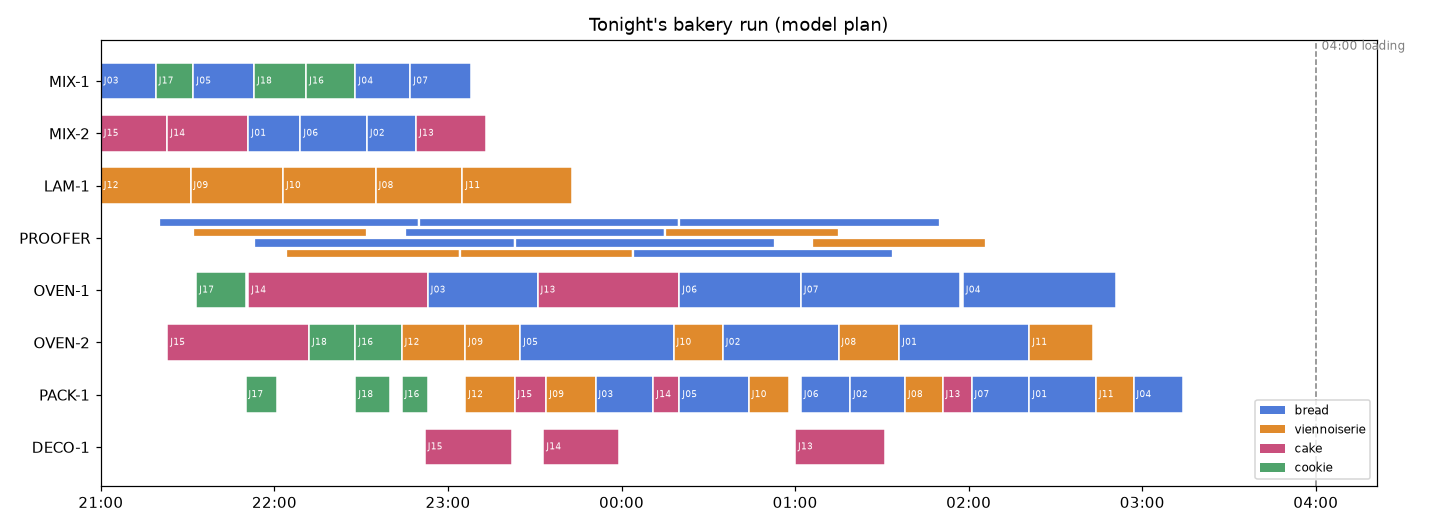
Read the Gantt chart: the two ovens are the busiest machines; cakes and cookies go first (they don't need the proofer); breads are mixed early so their 90-minute proof finishes while the ovens are free.
Decision it supports: in what order each machine processes the night's jobs.
Other decisions you can support the same way: print shops · machine shops · hospital operating rooms · software build pipelines · laboratory instruments.
34.4 A short-staffed night
With only one mixer operator and one oven crew, not everything can be ready on time. Now the objective matters.
# ---------- 34.4 A short-staffed night: one mixer, one oven ----------
for objective in ("makespan", "lateness"):
    s3, st3, sc3 = solve_schedule(build_schedule(jobs, ops, machines, rules, one_of_each=True, objective=objective), ops)
    report(f"one mixer and one oven, objective {objective}", sc3)
    print("    late:", {j: f"{v} min" for j, v in summary(sc3, jobs)["late"].items()})
one mixer and one oven, objective makespan: done at 08:04; 7 late jobs, 1102 minutes late; 0 rule breaks
    late: {'J03': '174 min', 'J04': '128 min', 'J05': '221 min', 'J10': '67 min', 'J11': '234 min', 'J13': '94 min', 'J16': '184 min'}
one mixer and one oven, objective lateness: done at 09:14; 6 late jobs, 564 minutes late; 0 rule breaks
    late: {'J04': '122 min', 'J06': '37 min', 'J07': '197 min', 'J14': '194 min', 'J16': '1 min', 'J17': '13 min'}
- "Finish everything as early as possible" (makespan, proven optimal: 08:04) leaves 7 jobs late by 1,102 minutes in total.
- "Be as little late as possible" finishes later (09:14) but has 6 jobs late by 564 minutes: half the lateness. On a bad night, choose the objective that matches what customers feel.
The planted bug
day34/bug_precedence.py is a colleague's quick version of the model: "each step starts after the step before". Run it.
for job, g in ops.groupby("job_id"):
    steps = sorted(g.step)
    for a, b in zip(steps, steps[1:]):
        m.add(start[job, b] >= start[job, a])                 # each step after the one before
What happens, and why
OPTIMAL done at 07:36
57 rule breaks, e.g.:
    J01: proof starts before mix ends
    J01: bake starts before proof ends
    J01: pack starts before bake ends
    J02: proof starts before mix ends
"Optimal", and 57 rule breaks: proofing starts before mixing ends, baking before proofing ends. start[b] >= start[a] says the next step starts after the previous one starts; it must be start[b] >= end[a]. With interval variables the end is always there: use it. The checker, written separately, found what the solver couldn't.
Mini-project: can the night crew start later?
The night crew would like to start at 21:30, 22:00 or 22:30 instead of 21:00 (the shift premium is lower before midnight, and it's easier to staff). The 04:00 loading and the cake deadlines don't move. How late can the run start with nothing late?
Solution
"""Day 34 mini-project: the night crew asks to start later. How late can tonight's run start
with nothing late at 04:00 loading?

Run from the repository root (after day06/load_tables.py):  python day34/mini_project_start.py   (about 1.5 minutes)
"""
import sys

import duckdb
import pandas as pd

sys.path.insert(0, "day34")
from bakery_shop import build_schedule, check_schedule, clock, load_shop, solve_schedule, summary

pd.set_option("display.width", 160)
con = duckdb.connect("northbound.duckdb", read_only=True)
jobs, ops, machines, rules = load_shop(con)
rows = []
for delay in (0, 30, 60, 90):
    later = jobs.assign(due_minute=jobs.due_minute - delay)       # same clock deadlines, less time to meet them
    m = build_schedule(later, ops, machines, rules, objective="lateness")
    solver, status, sched = solve_schedule(m, ops)
    s = summary(sched, later)
    rows.append((clock(delay), clock(s["makespan"] + delay), s["late_jobs"], s["minutes_late"],
                 ", ".join(f"{j} {v}" for j, v in s["late"].items()) or "-",
                 int(solver.best_objective_bound // 1000),                  # proven: no plan is less late than this
                 len(check_schedule(sched, later, machines, rules))))
print(pd.DataFrame(rows, columns=["start", "done_at", "late_jobs", "minutes_late", "late (minutes)", "at_least_late",
                                  "rule_breaks"])
      .to_string(index=False))
start done_at  late_jobs  minutes_late late (minutes)  at_least_late  rule_breaks
21:00   03:18          0             0              -              0            0
21:30   03:43          0             0              -              0            0
22:00   04:41          0             0              -              0            0
22:30   05:52          1            14         J06 14              2            0
- Starting at 21:30 or 22:00, nothing is late. At 22:00 the run finishes at 04:41, after loading starts, but the last jobs are cakes and cookies due at 05:00 or later.
- At 22:30, at least 2 minutes of lateness can't be avoided: CP-SAT's bound proves it. The plan it found is 14 minutes late on one sourdough job.
Note to the bakery manager: "The night run can start at 22:00 instead of 21:00 with every deadline met. Note that the run then ends at 04:41, so the vans would load the last breads at about 04:00 and the cakes later. Day 37 checks what a later dispatch costs on the road."
Commit
git add .
git commit -m "Day 34: job-shop scheduling of the bakery run"
git push
Day 34 checklist
- I can model a job shop with interval variables,
NoOverlapand precedence. - I can model a machine choice with optional intervals and a shared capacity with
Cumulative. - I can add maximum waits between steps.
- I compare makespan and lateness objectives and say which fits the situation.
- I use deterministic work limits and report the bound with the plan.
- I check schedules with an independent checker.